Key Takeaway: Successful autonomous transit deployment begins long before vehicles operate without a safety attendant. It starts with agencies investing in people, infrastructure, operational processes and long-term institutional expertise.
Recently, I had the pleasure of being personally invited by Nat Ford, CEO of the Jacksonville Transportation Authority (JTA), to Jacksonville to assess the Neighborhood Autonomous Vehicle Innovation (NAVI) shuttle service. My visit took place exactly one year after the service entered operation.
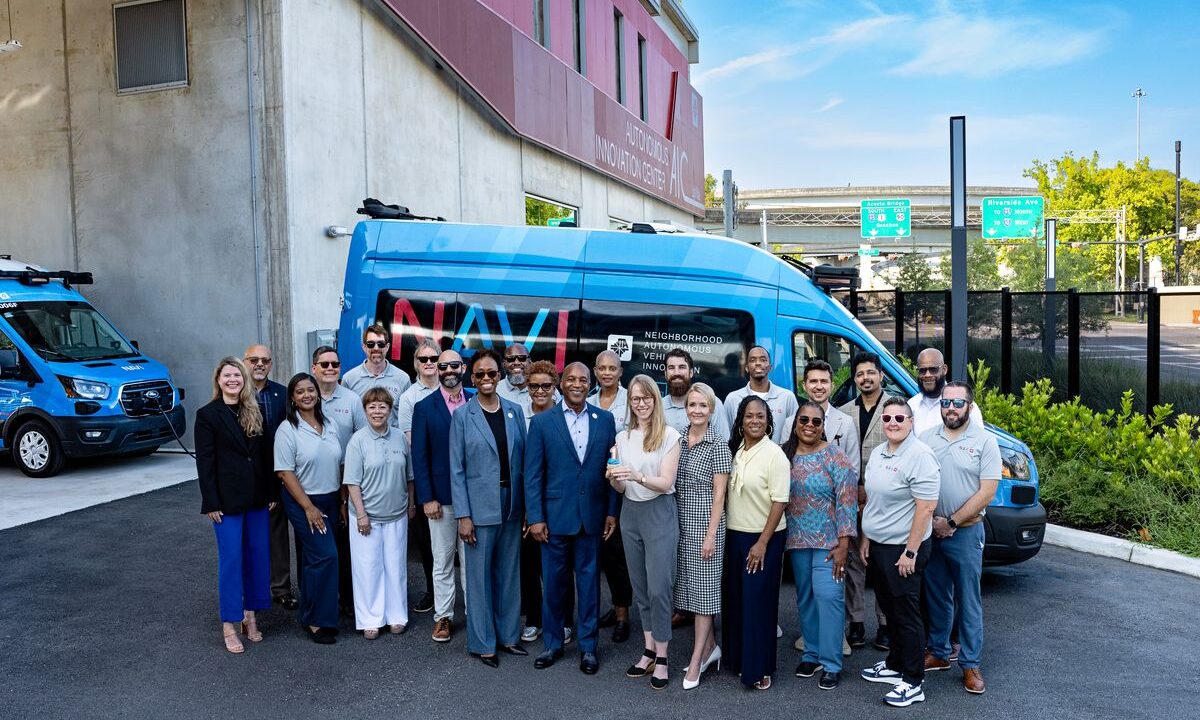
Reaching a full year of continuous passenger service is already a noteworthy milestone in the autonomous transit sector, where many deployments have historically remained short-term demonstrations or pilot projects. That impression was reinforced the moment I arrived at JTA’s maintenance and operations facility. Instead of finding a handful of vehicles prepared for a showcase, I saw a fleet of autonomous shuttles lined up, undergoing their morning checks before heading out into service. It was immediately clear that this was no longer a pilot – it was an operational transit service, with the routines, infrastructure and workforce that come with running public transportation every day.
And having worked on autonomous mobility deployments across Europe, Asia, and North America – including coordinating one of Europe’s largest demonstrations through the €30 million SHOW project – I rarely come across projects that genuinely surprise me.
Jacksonville did, not because everything is perfect, but because the agency is building something far more important than an autonomous shuttle route.
It is building the foundations for the next generation of public transportation.
A Vision That Started Years Ago
I first met Nat Ford in 2023 when Jacksonville hosted the UITP North America Conference. During that visit, I toured JTA’s Autonomous Innovation Center and participated in a panel discussion on automated mobility.
Even then, it was clear that JTA’s ambitions extended well beyond deploying autonomous vehicles.
Nat Ford has consistently positioned Jacksonville as a place where public transportation can evolve – not simply by adopting new technology, but by rethinking how transit agencies prepare for the future. His leadership within the industry reflects the belief that modernizing public transportation is a collective effort that extends beyond one city or one state.
Equally striking during my recent visit was the team he has assembled: Every person I met demonstrated both technical expertise and a genuine commitment to making this long-term vision succeed.

Innovation Always Attracts Critics
Being an innovator is rarely comfortable.
Large infrastructure projects inevitably attract criticism, particularly when they involve emerging technologies.
Jacksonville has been no exception.
Using pulsur™, we analyzed online conversations surrounding the NAVI service. Public discussions frequently questioned the investment, while local media often highlighted one recurring theme: ridership.
These concerns are understandable since the current ridership remains relatively modest, and the investment required to launch an autonomous transit service is substantial.
Those facts are real – but they are also incomplete.
Ridership Alone Doesn’t Measure Success
One of the most common mistakes in evaluating autonomous transit pilots is judging them solely by today’s passenger numbers.
That overlooks the fundamental purpose of many first-generation deployments.
Historically, autonomous public transport has emerged first in cities with both the financial capacity and the political willingness to innovate. Whether in Europe or the United States, early deployments have often been located in economically strong regions able to absorb the costs and risks associated with testing new technology.
Jacksonville fits this pattern.
More importantly, downtown Jacksonville is currently undergoing significant redevelopment. Construction activity throughout the city is constantly modifying road layouts, creating detours, and changing traffic conditions.
Ironically, these same construction works currently limit the autonomous operation of the NAVI vehicles.
In one or two years, the operating environment could look completely different: Travel demand will increase, road infrastructure will stabilize and the service itself will evolve.
Judging the project today as though it were a mature transit system misses the point.
JTA Is Preparing for the Future
What impressed me most was not the vehicle, it was everything surrounding it.
Rather than waiting for private autonomous vehicle companies to arrive with turnkey solutions, JTA has chosen to build the institutional capability required to operate autonomous transit at scale.
That includes investing in:
- dedicated operations and maintenance facilities;
- charging infrastructure, solar generation, and battery storage;
- staff training and operational expertise;
- digital infrastructure capable of supervising autonomous fleets;
- procurement processes adapted to rapidly evolving technologies.
These investments may not generate headlines, but they represent the difficult work required before autonomous transit can become a reality.
Five Things That Stood Out
Several aspects of the deployment deserve particular attention.
1. Passenger-focused stations
The stations are modern, informative, and designed to reassure passengers. Clear passenger information and direct communication with an operations center help build confidence – an often overlooked aspect of autonomous mobility.
2. Traffic signal priority
JTA has implemented signal priority at selected intersections, making it easier for autonomous vehicles to merge and operate efficiently within mixed traffic.
3. Fleet supervision
Working with Beep, JTA operates a sophisticated monitoring platform capable of supervising vehicle status, battery levels, vehicle location, safety attendants, disengagements, and operational hotspots in real time. This operational intelligence is essential for continuously improving autonomous services.
4. Reusable procurement knowledge
The agency has developed detailed technical requirements that could serve as a reference for future deployments elsewhere in Florida, reducing duplication of effort for other public agencies.
5. Building institutional knowledge
Perhaps most importantly, JTA is developing expertise within the agency itself. Operating autonomous transit is not only about purchasing vehicles, it is about creating new capabilities across engineering, operations, maintenance, customer service, and regulation.
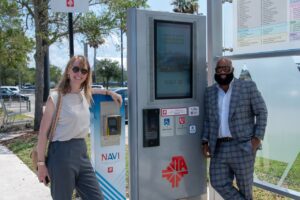

Together with Kelly Gonzales Jr, CEO of ProKel Mobility, we explored JTA’s stations and beep supervision center
The Vehicle Is Only Part of the Story
Interestingly, my evaluation was never primarily about the vehicle itself.
Technology suppliers evolve rapidly. Companies change strategies, markets consolidate, and business models shift. Today’s vehicle supplier may not be tomorrow’s long-term partner.
The ride itself was smooth overall, with only a few braking events that future autonomous driving systems will likely handle more gracefully.
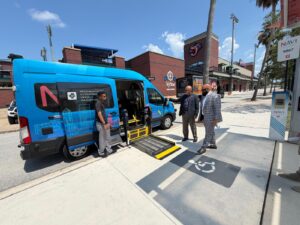
The current vehicle – an electric Ford van retrofitted with the OXA autonomous driving system and equipped with wheelchair accessibility – is functional but reflects the compromises typical of first-generation platforms. The accessibility ramp occupies a significant portion of the interior space, making boarding less comfortable than purpose-built autonomous shuttles are expected to offer.
That will improve as dedicated autonomous vehicle platforms, such as the upcoming HOLON shuttle, enter service.

Listen to the Urban Innovate TALKS episode with Alex Hansen, Director of Sales, USA at HOLON to learn more about their ambition.
One feature of the NAVI service particularly caught my attention during the ride:
Passengers can establish a live video connection with an actual person in the operations center.
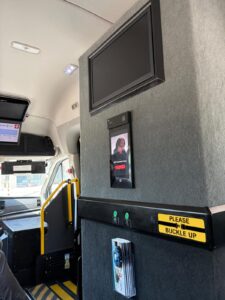
As autonomous services gradually move toward remote supervision instead of onboard safety attendants, maintaining this human connection may become one of the most important factors influencing passenger trust.
Technology alone does not create confidence… People do.
The Bigger Lesson for Transit Agencies
The Jacksonville NAVI project should not be viewed simply as an autonomous shuttle demonstration.
It is an example of how a transit agency can prepare itself for a future in which automation becomes one component of public transportation.
That preparation requires funding, certainly.
But above all, it requires leadership.
Nat Ford and the JTA team have demonstrated a willingness to invest in capabilities that many agencies will eventually need: operational expertise, digital infrastructure, workforce development, procurement innovation, and institutional learning.
For transit agencies wondering when they should begin preparing for autonomous mobility, my answer is simple:
The best time is before the technology becomes mainstream, not after.
FAQ
1. What is the NAVI service in Jacksonville? The NAVI service is an innovative autonomous vehicle transit system introduced in Jacksonville. NAVI stands for Neighborhood Autonomous Vehicle Innovation. Celebrating its first anniversary, it integrates digital and physical infrastructural investments to modernize public transit through autonomous vehicle technology.
2. What challenges does the NAVI service face? One significant challenge for the NAVI service is low ridership, partly due to ongoing downtown redevelopment affecting demand. However, these conditions are expected to change with the city’s continuing growth.
3. How is JTA preparing for the future of transit? JTA is investing in modern station infrastructures, specialized traffic lights, and robust monitoring systems to support autonomous vehicles. Their initiatives include training personnel and establishing extensive physical and digital infrastructures.
4. What are the unique features of the vehicles used in NAVI? The vehicles, retrofitted with OXA’s ADS stack and ramps for wheelchair users, also feature a video connection to a call center. This allows passengers to communicate with an actual human, enhancing customer service experiences.
5. How will the NAVI service expand in the future? Future expansion plans involve introducing new vehicle models, such as HOLON shuttles manufactured in Jacksonville, and further optimizing the service to extend accessibility to public transportation and reliable mobility for all.
Planning or operating an autonomous mobility service? At Urban Innovate, we help agencies and operators evaluate AV deployments through our Urban Innovate Evaluation Framework looking beyond traditional KPIs to assess operational readiness, user experience and long-term impacts. And if you’re curious about how your community perceives your transit system today, pulsur™ transforms public narratives into actionable insights to support better decision-making. Feel free to get in touch or explore our services to learn more.