If you’ve spent any time following the world of self-driving vehicles, you’ve almost certainly heard someone say “Level 4” or “Level 2+” — but do those terms mean what you think they mean? In our latest episode, I sat down with Steve Shladover, one of the most respected figures in vehicle automation research, to cut through the hype and get back to basics.
Steve has been in this field for over 50 years — yes, 50 — starting with a master’s thesis on automatic steering control at MIT in 1973, followed by a doctoral thesis on automated vehicle platooning in 1978. Since then, he’s led research at the University of California, Berkeley, helped shape the SAE and ISO standards that define the language the entire industry uses, and most recently advised California’s regulators on the rules governing the testing and deployment of automated driving systems. If anyone can explain what these levels really mean, it’s Steve.
More Than Just a Number
Before diving into the levels themselves, Steve made an important framing point: the SAE levels of automation are only one dimension of any automated driving system. Equally important is the Operational Design Domain (ODD) — the specific conditions under which the system is designed to operate — and the type of service the system is performing. Is it moving people or freight? Is it a fleet vehicle or a privately owned car? Urban or highway?
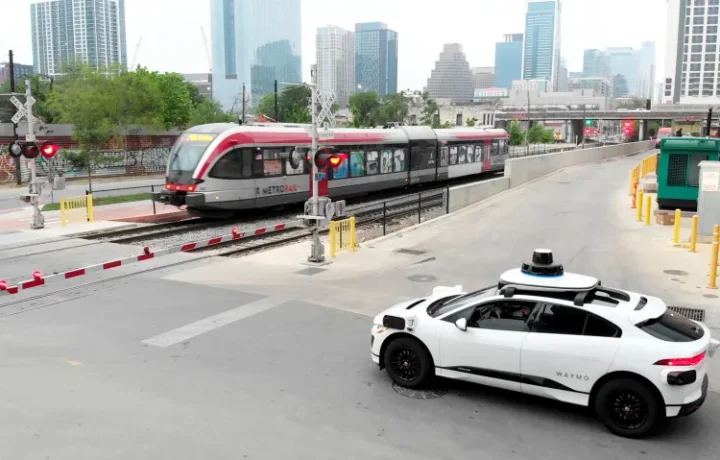
“A Waymo ride-hailing vehicle and an Aurora truck are both Level 4,” Steve explained, “but they’re dramatically different from each other.“
Trying to compare them purely on the basis of their automation level misses most of what matters.
He also flagged a common misconception worth correcting early: the levels apply to features, not to vehicles. A single car can have multiple features operating at different levels in different conditions. So when we say a vehicle “is” a certain level, we’re really shortcutting — and sometimes that shortcut causes confusion.
Level 0: No Automation (and Not All “Tech” Counts)
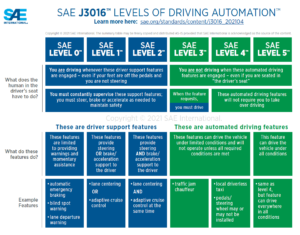
Level 0 is the absence of automation — a human driver doing everything. But Steve was quick to note that not every piece of technology in a modern car counts as automation. A parking warning beep, a forward collision alert, an emergency braking system that fires once and returns control to the driver — these are warning and safety intervention systems, not driving automation.
Why? Because driving automation, as SAE defines it, means the sustained performance of part of the dynamic driving task. A system that only kicks in intermittently doesn’t change the fundamental division of roles between driver and machine. It doesn’t qualify, even as Level 1.
Level 1: One Hand on the Wheel (Figuratively)
Level 1 is the first genuine rung of automation. The system takes over either longitudinal control (speed and following distance — think adaptive cruise control) or lateral control (steering to keep the vehicle centered in the lane). Not both — just one or the other. The driver is still fully responsible for everything else, including monitoring the road and the system.
Level 2: Both Axes, Still Your Responsibility
At Level 2, the system handles both longitudinal and lateral control simultaneously — but the driver remains legally and practically in charge. This is the level where most consumer vehicles with highway driving assistance sit today.
The driver must continuously supervise the system. They cannot check their phone, look away, or mentally check out. And manufacturers must include driver monitoring to enforce this — early systems used steering wheel torque sensors (which drivers quickly learned to trick with a beer can), while modern systems use infrared cameras to track eye direction and detect drowsiness.
On the subject of “Level 2+”, Steve was direct: “That’s total bullshit.” It’s a marketing label, not a technical standard. A system that monitors your eyes instead of your hands is still Level 2 — the driver still needs to supervise continuously. The monitoring technology changed; the human’s role and responsibility did not.
Level 3: The Tricky Middle Ground
Level 3 is where things get complicated — and where the market has largely struggled.
At Level 3, the system performs the complete dynamic driving task under certain conditions, and critically, it has enough self-awareness to know when it’s about to reach the limits of those conditions. When that happens, it issues a takeover request to the driver, who must be ready to resume control — quickly.
This creates a genuinely difficult human factors problem. The driver is allowed to disengage mentally (they don’t need to continuously supervise), but they must be capable of snapping back to full attention within seconds when called upon. You cannot be asleep. You cannot be deeply absorbed in something else.
The technical requirements are also significantly higher than at Level 2, because the system can’t lean on the driver as a backup monitor — it has to handle that itself, with redundant sensing and actuators. All of that cost buys relatively modest benefit compared to Level 2 — the driver is still physically present and must remain capable of taking over.
“I don’t predict a big future for Level 3,” Steve said frankly. “It’s more of a stepping stone toward Level 4.“
BMW has pursued it, but uptake has been limited. The cost-benefit equation is challenging.
Level 4: The Real Leap
Level 4 is where things genuinely change. The system performs the complete dynamic driving task and can achieve a safe state — pulling over and stopping — under any hazard or fault condition it encounters, without requiring human intervention.
This is what makes truly driverless operation possible. The vehicle doesn’t require a licensed driver in the seat. It can serve passengers who are elderly, too young to drive, or simply not paying attention. It’s the foundation of Waymo’s robotaxi service and Aurora’s trucking system.
But Level 4 is always bounded by an ODD. Waymo, for instance, operates within specific geographic areas, weather conditions, and traffic environments. As those systems mature, companies expand their ODDs — not just geographically, but across weather, lighting, and intersection complexity. (An interesting example Steve gave: some systems deliberately route around unprotected left turns they’re not yet confident handling.)
On the question of where Level 4 is having the most impact, Steve offered a view that may surprise some: trucking, not urban ride-hailing, is the more compelling near-term application. Driver hours-of-service regulations mean a human trucker can only drive 11 hours a day. An automated system could run 20 hours. That’s nearly double the asset utilization for an expensive piece of equipment — and it gets fresh produce from coast to coast in two days instead of four or five. The economics are hard to argue with.
For urban mobility, Steve sees a hybrid future as more realistic than full replacement: a mix of automated and human-driven vehicles, with automation handling off-peak periods and human drivers covering the surge. Singapore’s Land Transport Authority is already piloting exactly this model on a regular bus route.
Level 5: The Unreachable Ideal (By Design)
Level 5 is full driving automation with no operational design domain constraints — the system can drive anywhere a human can drive. Steve was honest: he believes this is effectively unachievable, both technically and economically.
“The difference between Level 4 and Level 5 is bigger than the difference between Level 4 and Level 1.“
Getting there would require combining every possible Level 4 system, proving safety across every conceivable condition, and commercializing it even in the most remote, lightly-traveled corners of the world. No viable business case exists for that.
So why define it at all? When the taxonomy was first being developed, there was enormous hype about automation taking over everything. Level 5 was defined specifically to name and quarantine that vision — to make clear where the realistic horizon of development ends and where the aspirational fiction begins.
Where Does Tesla Fit?
No conversation about automation levels is complete without addressing Tesla’s Autopilot and “Full Self-Driving” branding. Steve’s view: Tesla has a Level 2 system — one that requires continuous human oversight — dressed up in marketing language that implies something more.
“Look at what’s in the owner’s manual,” he said. “That’s the legally binding document. It makes clear the driver needs to continuously supervise.“
He described Tesla as “a Level 4 wannabe” — a company that has been claiming full autonomy is imminent for nearly a decade without the technical architecture (camera-only sensing, insufficient redundancy) to actually get there. The confusion this creates in the public is, in his view, a real problem.
A Word on “Autonomous” vs. “Automated”
One final terminology note from Steve: please stop saying “autonomous.” The SAE standard explicitly says you should not use the word, and for good reason. “Autonomous” means independent and self-sufficient — a vehicle that requires no outside data. “Automated” means a machine is taking over functions previously performed by a human. These are different things. Automated is the right word. Autonomous sounds fancier, which is exactly why it caught on — but it muddies rather than clarifies.
Why This Still Matters
The levels of automation were never designed as consumer-facing communication tools. They were built to give engineers, regulators, and lawyers a shared vocabulary — so that when something goes wrong, everyone agrees on what the system was supposed to do and who bore responsibility for what.
That shared language is more important than ever as these systems move from research labs to public roads. Steve’s work — spanning research, testing, public demonstrations, standards development, and regulatory advising — has been central to making that language coherent.
FAQ
What are the SAE levels of automation?
They’re a standardized framework (0–5) that defines the division of roles between a human driver and an automated system. Level 0 is no automation at all; Level 5 is full automation under any condition a human could drive in.
Does my car have a level of automation?
Technically, no — levels apply to features, not vehicles. A single car can have multiple features operating at different levels in different conditions. When people say a car “is” a certain level, it’s a simplification.
What’s the difference between Level 2 and Level 4?
At Level 2, the driver is still responsible and must continuously supervise the system — it’s assistance, not autonomy. At Level 4, the system can handle the full driving task and safely stop itself if something goes wrong, enabling truly driverless operation within defined conditions.
Is Tesla a Level 4 vehicle?
No. Despite its “Full Self-Driving” branding, Tesla operates a Level 2 system that requires continuous human oversight. The owner’s manual makes this clear, even if the marketing does not.
Should I say “autonomous” or “automated” vehicles?
Automated. “Autonomous” implies independence from any outside input, which isn’t accurate for these systems. The SAE standard explicitly advises against using the term — it sounds impressive but creates confusion.
Watch the full episode on YouTube, Transitor, and find links to the SAE J3016 standard and the upcoming Automated Transportation Symposium in San Diego (final week of July) in the episode description.